
From his work as a botanist on Long Island, near New York, to his return to Calabria to launch the Il Tesoro di Roseto Community Cooperative, with the goal of reviving the historic cultivation of the Damask rose. The inspiring story of Mattia Nigro, a 30-year-old from Roseto Capo Spulico in the province of Cosenza, was made possible thanks to the support of the CEI’s Policoro project, which has now celebrated its 30th anniversary. Thirty years of guiding thousands of young people in the search for and realization of their professional calling, during which the project has contributed to the creation of hundreds of entrepreneurial and cooperative initiatives, first in the South and then throughout the country. In this way, it has also given many so-called “brain drain” professionals like Mattia the opportunity to return home. Because the goals that should be inherent to public service are not always pursued by public officials: in Italy as well as abroad, the third sector also takes on this role, as do religious organizations such as the CEI. Following the interview with Mattia Nigro, we turn to Don Marco Ulto, who just a few months ago became the new national coordinator of the Policoro project, and who explains: the project aims to grow further, and for this reason it will also change its name to Generazioni in rete.
Mattia, can you tell us how it went?
I left Roseto Capo Spulico to study Agricultural Sciences at the University of Florence. I left Calabria because of a lack of social life and work: at twenty, you’re looking for parties, you’re looking for friends, as well as studying. After a few years, I also had the opportunity to go to the United States for an internship—a job arranged through the university—at the Old Westbury Gardens botanical garden on Long Island, near New York. A beautiful place, surrounded by nature, unspoiled, a gigantic botanical garden—basically exactly what I’d dreamed of: being in touch with nature and working with plants. I worked there for a year and a half, and I had the opportunity to stay. There were two Calabrian men in their seventies who had emigrated there at age 18; these two gentlemen often spoke to me about Italy: “Why are you here? Why don’t you go back home?” They told me that back home, you truly experience friends, family, and people—both the good and the bad—and everything is much more traditional. They really missed Calabria. Their stories, and the fact that I wanted to take a chance, pushed me to say: let’s try, let’s experiment, and in the end I returned to Calabria. Dreams grow, they become richer; the ecosystem you want around you—at least the one I wanted—was made up of plants I love so much, but above all of human relationships.
How did the move back go?
Having had an experience abroad, I realized what I was looking for: nature, tranquility, healthy food, human relationships—all things that abound in Italy, but in Southern Italy in particular. Where I live, it’s easy to know where the food you eat comes from; it’s easy to look people in the face every day. This fueled everything; I committed myself and said: okay, I’ll open a campground, and then a farm. Thanks to this campground, I learned about the Policoro project, and from there another adventure was born—which is precisely the fact of looking people in the face, of observing and listening to what’s around me. I told myself: the real problem here is social life; young people can’t stay because they want to find work, to have a more dynamic life—so why don’t we get together and try to do something together? Why don’t we create work, live it in a different way, putting our passions at the center, our desires?
How did you manage to put this insight into practice?
We got together with other young people, thanks to a process we also undertook with NEXT, a national network based in Rome that works to promote a model of civil, sustainable, and participatory economy, and carries out training activities, research, and operational tools for businesses, schools, and local communities. We underwent training, and thanks to the Policoro project, with the motto “Youth, Gospel, and Work,” I also contributed my own ideas. Until three months ago, we established ourselves as the community cooperative Il Tesoro di Roseto, with the aim of enhancing what the local area already offers, valuing the existing human ecosystem, and connecting ancient traditions, reinterpreting them in a modern way—that is, without distorting what the place offers, but bringing something new to it, transforming it.
For example?
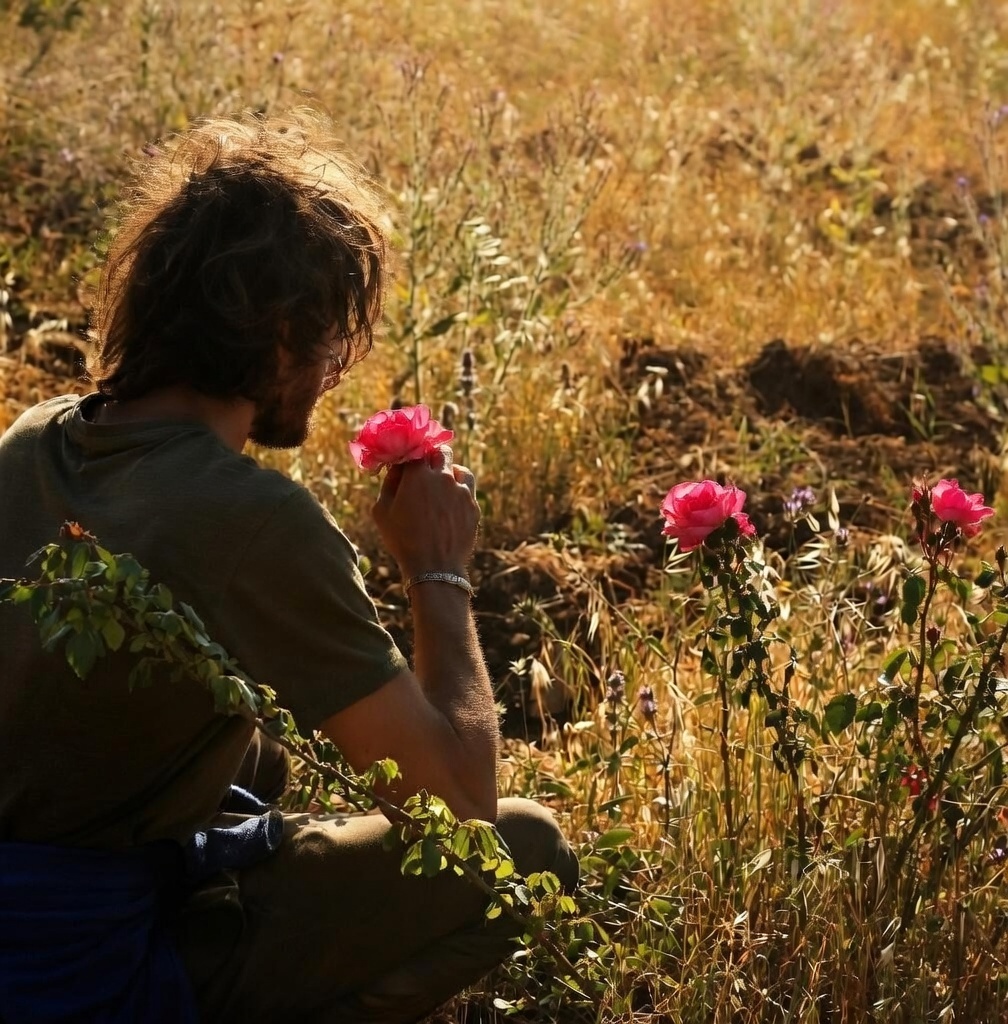
The name Roseto comes from the Latin *rosetum*, referring to the widespread cultivation of roses during the Greco-Roman era, which were used to stuff the pillows of the sybaritic princesses. Together with the cooperative, we created a community map—that is, a map of the local area’s needs. We went out to talk to people, in schools, everywhere: Roseto is a small town; we spoke with maybe a thousand, twelve hundred people, because on paper we’re two thousand, but then everyone’s away. From these people emerged this community map: many said, “We’re in Roseto and there are very few roses.” People want to see this rose again, so we took this direction. In Roseto Capo Spulico, we have the castle by the sea and Frederick II’s stables; there’s this Frederickian influence, and he likely brought the rose here as well. According to tradition, the rose that was cultivated was the Damask rose. But even before the Damask rose, there was the Gallic rose of the Sibaritide, because Roseto Capo Spulico was part of ancient Sibari, which bordered Siri, with whom it had good relations. So this Gallic rose was cultivated, and then, with Frederick II, the Damask rose, brought here from his travels to Damascus. So, with the cooperative, we decided: let’s start right here, with the Damask rose. That’s how these workshops where we make pillows came about, and Antiche Essenze di Calabria was born—another company we opened with two young people, a collaboration to produce essential oils and aromatic waters. With some cooperative members who are passionate about pastry-making, we’re now developing this rose and rosemary pastry, which is very popular here. As a botanist and nature lover, I’m very excited about the project. In the direction the cooperative is taking, each of us brings our own passions, but also what the community wants—and thus what emerged from this community map.
How many of you are participating in this project?
As a cooperative, we started with 16 people; now there are 40 of us, mostly young people between 20 and 25 years old, then there are a few in their thirties like me, and 7–8 people in their forties. We don’t have a wise elder yet; I’m trying to convince my uncle to join us too. The elderly are truly lonely; sometimes they even become a problem, unfortunately, for many people—something that didn’t happen 60 or 70 years ago, at least according to the stories of my grandparents and our grandparents: grandpa and grandma were considered wise people, and they looked after the children. It was nice to be with the elderly. Yes, sometimes they gave you big lectures and it was even a bit of a drag, but they always enriched you with something, both mentally and emotionally, based on what came up among us. So we said to ourselves: why don’t we involve the elderly and let them get involved with us?
How so?
For example, there was a really nice idea: moms complain that there aren’t any babysitters in Roseto, so why not have the kids stay with the elderly? Like they used to do back in the day? In our project, the elderly person becomes the babysitter, because we believe they are enriched by the children—in the sense that they are enriched because they continue their work, they feel they can still do something for the community, passing on their knowledge, which I believe is the most beautiful thing of all. The children are thus with a person who speaks of their traditions, tells stories, and they are nourished by something they might also receive from books, but in a colder way. Still on the topic of tradition, there’s also an ethnographic museum here, where rooms are set up as they once were, with old photos, letters, and artifacts from the 1800s. We’re working with the cooperative to renovate it, and we want to take it over in partnership with the municipality to make it interactive. There are old-fashioned toys, and someone tells you about them, lets you play with them—like the spinning top or the spinning wheel.
Have a lot of young people left Roseto Capo Spulico?
Unfortunately, many friends have left; they only come back in the summer, for the festivals: some are in Germany, some have gone to France or Switzerland, and others are in Turin and northern Italy. Why? Because of issues related to work and social life. Just the other day at the cooperative, there were these two girls who said: “We want to stay in Roseto; we don’t want to move up north. Let’s find a way to do something, to create jobs, and to work together!” They joined us because we’re building this rose maze, along with another Hungarian man from the cooperative, Zoltan, who fell in love with Roseto and moved here. His enthusiasm rubbed off on them too, because while building this artistic maze we were all working together; a wonderful group of 12 people formed. We all had fun working, because it’s not just mechanical labor—we interacted, exchanged ideas; it was really great. And just yesterday the girls told us: let’s keep this up so we can stay here, come on. And they got excited. One of them, who’s passionate about cinema, immediately suggested: why don’t we set up a drive-in, why don’t we start a film school? I’d seen her looking downcast, she wanted to leave, but now she’s come alive again, she’s re-energized. I think it’s working, and I’m happy.
Is it tiring?
It’s very tiring, because there are so many internal dynamics that are pretty heavy, but it’s great, and it was exactly what we needed. Don’t get me wrong, there are also some really great employers, but a lot of the time you’re exploited, you get paid poorly, and you have to do extra work that nobody acknowledges. Or it’s a job completely different from what you’d like to do, from your passions. Maybe you want to be a musician, and your parents say: no, you have to be a doctor, you have to do this other thing… then you realize that making a living from music might be very difficult, so you give up your passion. Actually, the goal we set for ourselves as a cooperative is to nurture those passions and connect them through a network. In this, the Policoro project gives us a huge helping hand because there’s a massive network. Take my example: I make jams, and Policoro has already connected me with everyone. There’s a cooperative that’s going to make rose-scented waters, and everyone’s already interested. Want to make music? I know people in Turin who have a venue. So Policoro is like our mom who knows everyone, our dad who knows everyone, who helps us and even trains us.
In your experience, are there many young people who might be living abroad but who, if they had an interesting opportunity, would actually prefer to stay?
Yes, yes, absolutely yes. I believe—at least from what I’ve heard in the area—that in our province of Cosenza, everyone would stay. Or rather, they should go away first because, in my opinion, it’s good for everyone to go away for a year to realize what’s out there. But I know many would gladly come back.
Just like you did…
Exactly. The human connections I remembered here—the contact with my family, my cousins, my relatives—are completely different. I missed them, my family of course, but especially those relationships in southern Italy. I don’t want to sound like a local patriot, but unfortunately they’re sometimes very dramatic—and that’s okay—sometimes very sincere, beautiful, simple, but they’re full of life; you can feel it. Because compared to where I lived in the United States, the pace here is completely different. Here you can at least afford to enjoy your coffee in peace; there’s an unbelievable slowness compared to New York. But that slowness is what makes all the tourists fall in love with the Italian style—slow and peaceful—because it at least lets you listen to yourself, to do things with a certain rhythm and not be “boom boom boom” immediately propelled into doing something at a frantic pace: that’s not a human rhythm; it’s a rhythm we’re trying to impose on ourselves, but it’s not our own.
What are our rhythms?
They’re connected to those of nature, to a slowness that isn’t even bad to call slow, and it’s pleasant. So yes, from Long Island to here you feel a huge difference; I’m glad I did it and I recommend it to everyone. That’s why I say “return,” because it’s important to have an experience outside your usual context—it opens your eyes, lets you see the world from a different perspective, and maybe even gives you something to add to your resume, some experience that could be useful. But then maybe you realize that that experience is useful for your own community, that it helps integrate it into the ecosystem around you, and then you realize that’s the most beautiful thing, what we truly desire.
Don Marco Ulto, who has been the new national coordinator of the Policoro Project for just a few months. Could you briefly describe the project’s 30-year history?
Thirty years of the Policoro Project are nothing less than 30 years of intertwined stories, of hands clasped together, of eyes locked in each other’s gaze, of embraces, of dreams, and of vulnerabilities that have come together. This project has intertwined its life with that of over 3,000 young people from all over Italy, in very diverse contexts—from metropolitan cities to inland areas, from cities with a strong tourist presence to others with much less. In short, it has embraced almost the entire Italian territory, and the people who participated have built a network. Over the past 30 years, 500 concrete initiatives have been launched, carried out, and supported by the Policoro Project, so I believe these are significant numbers. Currently, 104 dioceses in Italy are participating in this project. Like any initiative, there has been a bit of a yo-yo effect; there are moments when that’s natural, I think, but our intent is to further expand the scope of the project. Not to boast about the numbers, but precisely because it’s an excellent opportunity, an excellent initiative, we want the reach to grow ever wider, so that more and more young people in our region can have people they can count on.
What is the main objective of the Policoro project?
I think it all boils down to Youth, Gospel, and Work—the three hashtags that have always, for 30 years, accompanied this experience and will continue to do so in the future. It places young people at the center, where they are not spectators but protagonists. To young people, I also like to quote the words of Gilda Falcone: as a concrete gesture, we ask young people for projects, we ask for dreams, and we stand alongside these young people to help them, in short, realize what they have within them. And the dynamic of the Gospel is the dynamic of evangelization: finding one’s place in the world means responding to a vocation, to a call. We do not act solely for ourselves, but the dream I carry within me, the promise I carry within, in reality seeks nothing other than to bring about the kingdom of God here and now through our lives, and it does so through the dynamic of work, which is not reduced simply to capital but is the fulfillment of a life, the fulfillment of a vocation, a concrete response to a call—and this will allow work to become a place of sanctification and humanize it, where people are truly at the center.
Has it often happened that your projects, your individual initiatives, have been established—as I have seen happen on occasion—on sites confiscated from organized crime?
Yes, among the supply chains that support and have signed a collaboration agreement with the Policoro project on a national scale is also Libera, which, together with other supply chains, promotes steps toward legality and justice. And thanks to their contribution—as well as that of every supply chain—we have managed to break away somewhat from the established patterns and challenge the notion that “this is how it’s always been done,” even even where there might be a certain mindset—and perhaps I’m saying things that are quite strong—where people probably sometimes give in to certain things. It breaks the mold a bit; that’s what I mean. So, taking concrete action on property confiscated from the Camorra or the Mafia means saying that change is possible, that steps toward legality are possible, that a different mindset—a new mindset—is possible.
And what about the slowness Mattia was talking about?
The Policoro project has established, shaped, and at times even fostered slow relational processes that don’t rush to judge the other, but scrutinize them, delve deep; and for this web of relationships to truly be substantial and real, it needs time. This time then generates a network so strong that even years later it remains real—it’s not just something emotional.
How important is the repopulation of inland areas to the project?
The Policoro project is not a process of isolation in inland areas, but rather one that provides a genuine, 360-degree opening on a national scale. Of course, the goal is to repopulate them, but this, too, is a process that is just beginning. We also need participation at multiple levels for this to happen. I come from an inland area, the Campania hinterland, and I am aware of its unique characteristics and its beauty—just as the entire Italian peninsula is full of them. In my view, we must not view inland areas merely as places to be passed through—even by tourists, because that is the risk—but rather as places to be inhabited. Often, basic services are lacking: schools, pharmacies, post offices, and hospitals that are always under the threat of closure.
How important is the repopulation of inland areas to the project?
The Policoro project is not about isolating inland areas, but rather about creating genuine, all-encompassing openness on a national scale. Of course, the goal is to repopulate them, but this is also a process that is just getting underway. We also need participation at multiple levels for this to happen. I come from an inland area, the Campania hinterland, and I am well aware of its unique characteristics and its beauty—just as the entire Italian peninsula is full of such qualities. In my view, we must not look at inland areas merely as places to be passed through—even by tourism, because that is the risk—but rather as places to be inhabited. Often, basic services are lacking: schools, a pharmacy, a post office, and hospitals that are always under the threat of closure. The Policoro project begins precisely by helping people discover the beauty and potential of those areas, and Mattia has spoken extensively about this. And then to stimulate other actors in the area, acting as a catalyst—even a small town in the Campania hinterland is worth living in—because this generates those virtuous cycles that make life worth living, in that slowness that is not sloppiness, not laziness, but attentiveness to the processes, respecting their timing. In short, our task is to shine a light and say that there are young people who want to stay, who have the right to choose whether to stay or leave, and that leaving is not the only option. This is our desire and our work.
What is the outlook for the project?
We are at a turning point. After thirty years, a project can no longer simply be called a project; it has established an identity, because if it hadn’t, it would mean it doesn’t work. This project has reached its culmination; the Policoro Project bids us farewell even in its name and will become Generazioni in rete as of January 1, 2027. This is not something that happened suddenly; it is a process that began long ago, a participatory process in which all the protagonists—the actors of this experience—are involved. We are not witnessing the end of the Policoro Project but its evolution. In Policoro, following the 1995 conference in Palermo, three bishops, enlightened by God’s grace, met and decided to join forces to launch this initiative. However, we cannot limit it solely to a region of Basilicata, a small southern town for which we hold fond memories: for this initiative to belong to everyone, we need to expand it on a national scale. If we exclude certain areas of our country—I’m thinking of certain regions—it’s as if we were depriving this experience of a holistic vision; it’s as if a part of us were missing. And so we want to broaden this vision by detaching it from the very definition of the “southern city,” and thus set it aside—not eliminate it—carrying it with us as intuition, as beauty, as prophecy, but then extending it to other territories.
Why Generations in Network?
It is the generativity that the Policoro project has possessed over these thirty years: of processes, of relationships. It has been creative, it has so often put concrete actions and gestures into practice. So “generations” is the sum of this meaning; they are the generations that have been touched by Policoro and those it still wishes to touch, and then the network will remain—the true fruit of these thirty years. A concrete, solid, steadfast, beautiful network that embraces without constricting, that does not capture, that does not make us prisoners but also has the capacity to set others free. It is a network in reverse, built on the pillars of this project that cannot be removed: young people, the Gospel, and work—no one will take that away. So Generazioni in rete—Youth, Gospel, Work—is the bet on the future, with grateful remembrance of the Policoro project but with open arms toward the future.