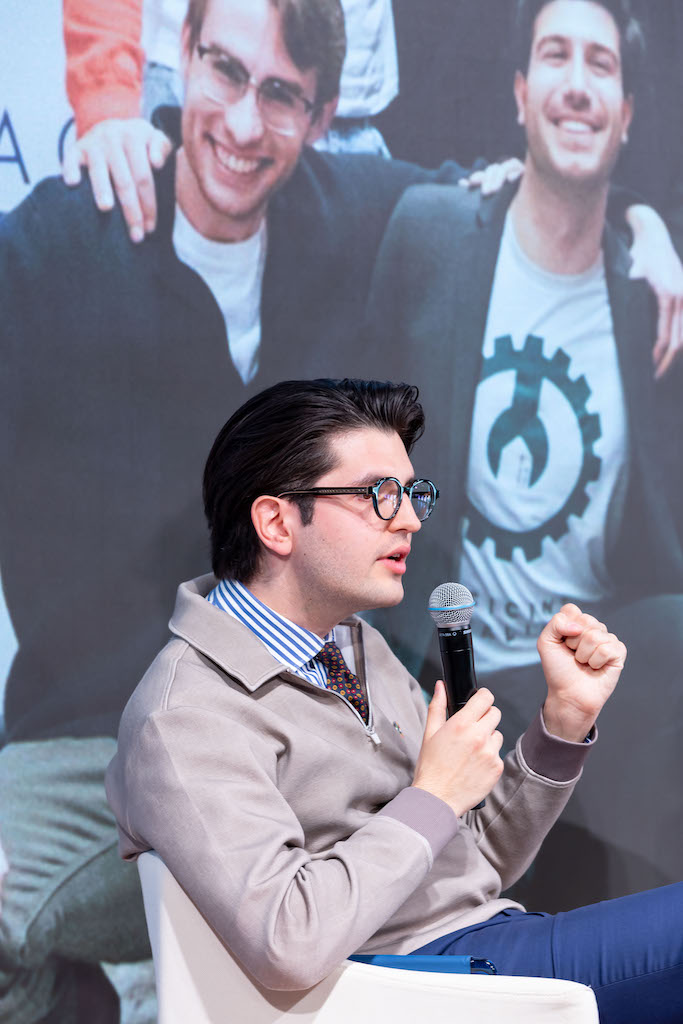

An association of young professionals united by the goal of building a more forward-looking and inclusive country, which activates and trains today’s and tomorrow’s decision makers to catalyze a change in the country’s trajectory. This is Officine Italia, which has chosen to focus on public service through the Officina project, a laboratory designed to involve young people under 30 in the innovation of public policies and public administration. The second edition took place in 2025 in collaboration with the municipalities of Brescia, Cinisello Balsamo, Monza, and Rho, and with the support of the Lombardy Region. At its presentation, Minister for Public Administration Paolo Zangrillo said, “Young people, with their energy, critical eye, and ideas, are our best allies in bringing change and innovation to public administration.” Driving Change interviewed Florian Sejko, a member of Officine Italia and the project manager who oversaw the second edition of Officina. He currently works at the European Central Bank, dealing with risk analysis and banking supervision. He was Italy’s delegate to the G7 Youth with the Young Ambassadors Society, focusing on demographics, fair taxation, and the cost of living for new generations.
How was Officine Italia born and for what objective?
Officine Italia starts in 2020 in a particular period, that of Covid, from a group of young professionals who have the ambition to change the trajectory of the Country, in a systemic and structural way. It is born on several programs and several initiatives: one that has become quite well-known is Uno Non Basta, a campaign to request more funds and targeted policies for young Italians in the National Recovery and Resilience Plan, because the 1% allocated to universities and education is not enough. A project that at the time was quite visionary, which then structured itself in practical terms with the Officina project, our flagship project, which started in 2023 with its first edition within the ministries. The project then evolved with edition number two which was done in the Municipalities. The idea is therefore to have young people who seek to change the Country, who seek to do it actively.
The theme of public service is quite neglected, especially in the Trumpian era: why did you launch a project focused precisely on this?
Because we believe that to change the trajectory of the Country it is important to start from where services for citizens are provided: public service, public administration, which has structural problems, the data say so. It is a sector in which employees exceed the trend of demographic aging: the average age is 48 years. So it suffers even more from the problems related to an aging population. It struggles more to innovate, to attract new talents. Public institutions tell us: we do everything possible to attract young people, but many calls go desert. They also call young people, the under 40s – for heaven’s sake, we are all young, but for us young people are the under 30s, the post-graduates… So for us the objective has always been to try to change the most important sector, which is also the one with the greatest need for young people, because it struggles to find them. This will become an even bigger problem in the future, because in fact this difficulty in attracting post-graduate boys and girls becomes even more problematic at the moment when their number decreases, while private companies have much less difficulty and also much more funds to be able to seek to attract this type of talent.
According to you, what is the main reason why there is this difficulty on the part of public service in attracting young people?
The problems are different, two more relevant. First, although there is a fairly concrete commitment to try to make recruitment methodologies smarter, easier, the truth is that it is much simpler to send a CV via LinkedIn rather than take a public competition to enter public administration. We realized this because, for example, for the Officina program we do not ask for participation in a competition: this makes it much simpler. Then to stay on indefinite contract you still have to take a competition, but the project gives them the possibility to work inside a Municipality, to realize what kind of work is done for six months without having the complication of taking a competition, and then do it eventually once they know the internal dynamics. Second problem, the way in which public administrations communicate themselves: as realities that are not really capable of innovating, that do not have presence of young people, and above all that do not give much independence and possibility of change to the young people who enter within them. This is the image that comes across, but in good part of the cases it is not so, in reality young people are rewarded and they are given independence within the public sector. This availability is much more present in local public administrations than in central ones, yet it is not possible to communicate it. By making this work experience to a greater number of young people, with word of mouth you can get the message across that working in Municipalities is not like in Checco Zalone’s films…
Is there also an issue of salaries?
Yes, there is a dual problem. The first is that salaries are low, especially within local administrations. The talents who are inside the Municipalities in fact tend to move to central administrations because there it is simpler to have a higher salary. It is also true that for young people the salaries of first jobs in the private sector are not that much higher, there is a general problem of stipends in Italy. Perhaps on the contrary it makes more sense to choose public work which has a much safer contract from the point of view of longevity rather than the private sector in a transformation situation like the one we are in: maybe by going to work in a consulting firm in two years you become little useful…
What is the engine that drives you to work in public administrations?
The problem we have seen is that the public sector, which is the one at the center of all the services that we consider banal and taken for granted, is the one currently most in difficulty: it is in crisis from the point of view of salaries, recruitment, innovation. This for us is a big problem for the future, so acting now maybe is a bit countercurrent, maybe it is not sexy, but it is the most useful thing to do. It is a problem that is worth our time, our interest, our sacrifice. Moreover, there are young people who when they finish the project remain inside the Municipalities, this gives us satisfaction and means a lot, as does seeing the Municipalities satisfied. Changing the trajectory of the Country is something that is done little by little, one Municipality at a time.
Can you tell us how the Officina project works?
We did a first edition within central administrations, which was a bit of a pilot project. Four guys were inserted inside the ministries for six months, as consultants for the PNRR: there was this possibility also without having to take competitions. An opportunity that arrived in a particular moment, straddling the end of the Draghi government and the beginning of the Meloni government. There were some complications, because there had been an initial insertion with a certain type of staff inside the ministries which then changed. Beyond this we realized that it was more complicated to make concrete proposals inside the ministries, precisely because their structure is very bureaucratic and fixed. Precisely for this reason we realized that it is more fruitful to work with Municipalities: that is what we did for the second edition. Specifically we worked with those of Monza, Cinisello Balsamo, Rho and Brescia, Municipalities of different sizes but relatively close from a geographical point of view, with similar interests. Also in this case we did an insertion for six months, in which the young people we call fellows of the project, entered for six months inside the Municipalities in different teams. So there was someone dealing with Europe, someone with European calls, someone with urban regeneration, someone with communication, this also based on skills. In these six months, every Friday the fellows did what we called experience, an activity to see beyond the internal work of the Municipality in collaboration with our project partners, third sector associations that work in the field of inequalities, equal opportunities, children’s rights and so on, from Forum Diseguaglianze e Diversità to Fondazione Giacomo Brodolini, from Young Women Network to Movimento Giovani Save the Children, and so on.
What are the next steps of Officine Italia?
We are working on the third edition, which should start in the second half of this year, presumably in September. It should be with ten Municipalities, this time in more parts of Italy, up to the Center and if we succeed also with a cluster in the South. The idea that is taking shape is also to try to get the Municipalities to participate from the budget point of view, not so much because we need it from the subsistence point of view, because we could find funds also with external calls. But because at the moment when this program, as we would like, became structural, we would not always be only us of Officine Italia every year having to split into forty to find funds, do the collection and selection of people. We would like the Municipalities to also participate, so that the project could be autonomous and on as many Municipalities as possible, potentially all. Regarding the project just finished, therefore the first edition in the Municipalities and the second of Officina after the one in the ministries, we won a call from Regione Lombardia which then financed the salaries of the young people. It is as if it were an internship, which is also a type of contract and experience that public administrations and especially municipalities struggle to propose.
What happens after the six months?
Some fellows do this experience, realize they are not comfortable, and change sector: but it has not happened very often. What we have instead seen happen, for example with the Municipalities, is that two people remained working there after taking a competition. It is much simpler to do it when you know the work group, opportunities open up and also from the point of view of competition scores you have an advantage. So you are privileged not only because you are known, but because the scores reflect this type of experiences already had. Another fellow entered inside a Municipality as a political figure, so remained in this ecosystem; and another one is doing a PhD thanks to the experience gained in those six months. So some people remain inside the Municipalities, others in realities that are closely linked to public administrations. For us both cases are a victory.
Can the project return to central public administration?
It could, but it is not something we have in our plans for the reasons I said. It is more complicated to do concrete projects and insert young people inside central administrations. The substantial difference we noticed is that inside a Municipality a young person is seen as a resource from whom to draw teachings, with whom to confront. To say a banality, if the Municipality wants to communicate with a post on Instagram that it has undertaken a particular initiative it can ask the young person, who has more familiarity with the matter: public administrations also communicate to young people, so this aspect has value. This in central administrations does not happen as much as in local ones, in the sense that you go from being perceived as a resource to being more considered as a burden. Of course it depends a lot on the people who are inside each administration, on how they perceive this type of projects. If one day a ministry, a particularly interested minister were found… We have often spoken with the ministry of public administration, but currently this opportunity does not exist. As far as we are concerned it is an opportunity that would have a lot of value, but if we do not perceive it as useful for the people who would participate it makes no sense to realize it. It is useful maybe for the CV of those who participate, but it does not change the trajectory of the Country.
Do you believe that the perception of the role of public service among young people is improving?
Attention to public themes, yes. To make the opinion on the work of public servants improve, it would be useful for them to be more attentive to the themes that young people very often openly declare to have close, which are the themes of the future. The problem is that some themes that we care about, and that have often been the subject also of demonstrations all over the world, like climate change, are not addressed, are not seen as priorities. And it is not that young people are close to future themes because they are dreamers, some of them are and it is right that it is so as all generations of young people every time; but because the future is where we will live!