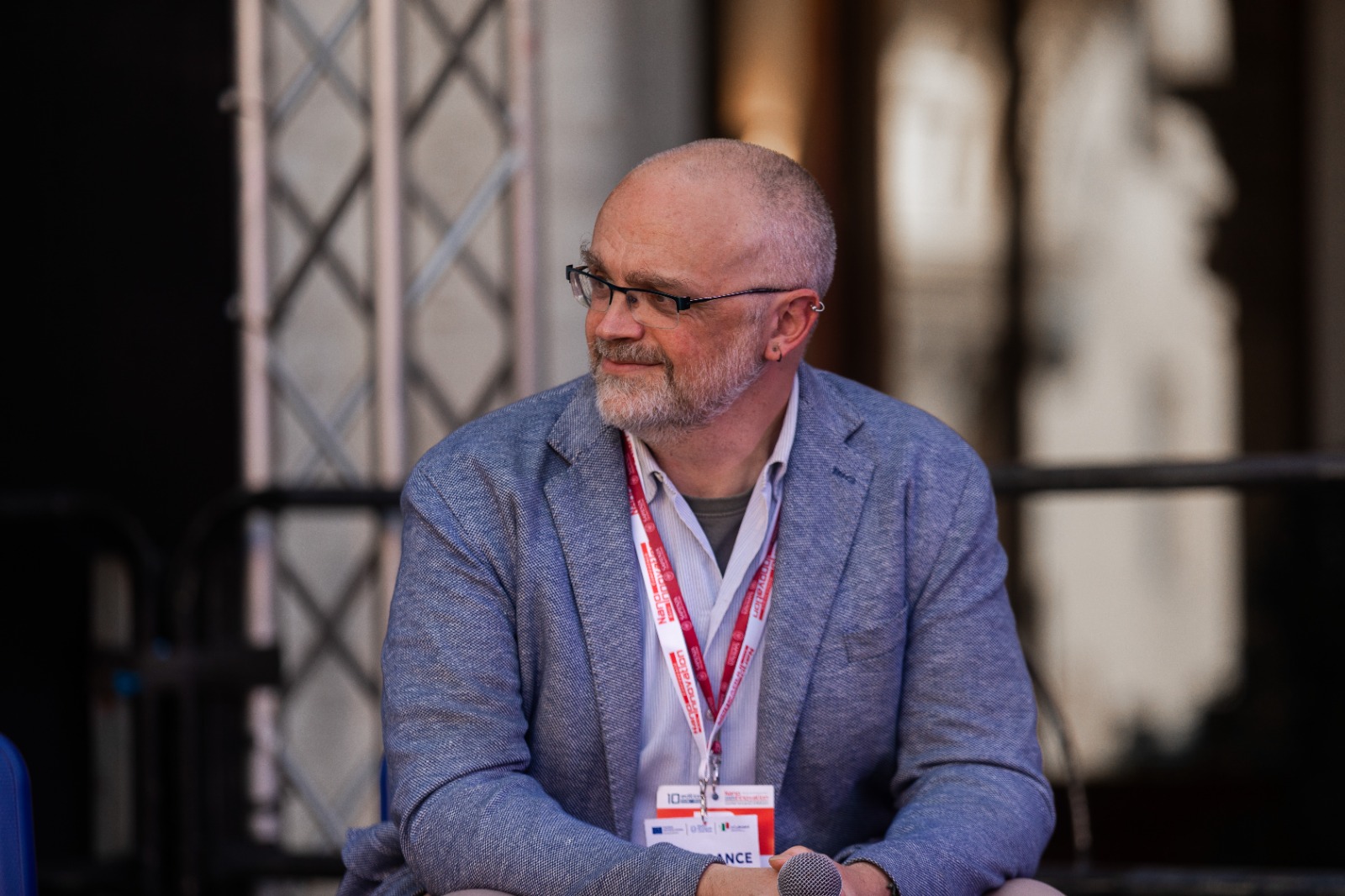

iEntrance: a new research infrastructure funded by the PNRR with over €70 million, created to provide companies, universities, and start-ups with advanced scientific tools and multidisciplinary expertise, with the aim of accelerating innovation in the key sectors of sustainable energy, green transition, and digital technologies. iENTRANCE stands for Infrastructure for ENergy TRAnsition and Circular Economy; it is coordinated by the National Research Council, with the involvement of INRiM, Sapienza University of Rome, Turin Polytechnic, University of Bologna, and Roma Tre University. A distributed network of laboratories operating in an integrated and synergistic manner, becoming a European reference platform for the development of new generation materials and technologies. “iENTRANCE is not just a collection of cutting-edge laboratories,” says CNR coordinator Vittorio Morandi in this interview with Driving Change, “but an open and collaborative community where research, businesses, and institutions can work together to transform knowledge into sustainable progress, sharing results that belong to the whole country and to the new generations.”
In which fields does it operate?
It is a new research infrastructure that has been created in a very broad field, that of materials science and technology: therefore, instrumentation, technologies, and know-how related to the use, optimization, and development of new materials. A scientific focus, however broad, that is a little more specific than all the issues of energy transition. Materials science is a very broad topic: exploitation, development, integration into devices, replacement of materials, rare critical materials are all aspects that have countless applications in almost all sectors. We have chosen to focus primarily on the topic of energy transition, considering it one of the key issues, although certainly not the only one, for the coming years, from energy generation to storage and recovery.
How does this activity work?
On the one hand, there is the issue of environmental monitoring, which is linked to fossil fuel consumption, pollution, and mobility; and on the other, there is the optimization and improvement of the performance of the devices and technologies we use to address the main issues related to energy transition. But there is also the materials front, because there are a number of technologies that are strongly linked to materials that in turn have critical issues, whether environmental in terms of pollution or supply. Promoting the energy transition also means trying to identify technologies and solutions that reduce costs and environmental impact, and implementing green technologies in device production as well. It is therefore necessary to look at processes from all angles, the ecological footprint of the production of materials and devices, and their life spans: in other words, life cycle assessment, what the environmental impact and duration of a product’s life cycle entails, and the integrated costs not only related to the individual device but also the environmental, management, and system costs. This is an extremely broad topic: the infrastructure was created with the aim of strengthening specific supply chains that enable it to be addressed.
Where did the project originate?
Its basis is linked to the European initiative focused on micro-nanotechnologies, called Euronanolab – so much so that its full name is Infrastructure for Energy Transition and Circular Economy linked to EuroNanoLab (ENL). It is a very large European network, comprising 46 nodes, nanotechnology facilities in 16 European countries, and coordinated by us Italians, all focused on micro and nanotechnologies applied in different fields. Starting from here, we have built a consortium capable of addressing the issue from other points of view as well, not only that of the integration of materials into devices, i.e., the manufacture of innovative sensors and devices, but also the entire supply chain linked to the characterization of materials, which also has the capacity to produce and generate new materials. We have tried to complete the picture and therefore to develop both more vertical themes on certain supply chains, such as activities related to batteries, energy storage, and generation, as well as cross-cutting tools, such as the development of characterization techniques. These can be pushed to very advanced resolutions to characterize the performance of devices and study materials under operating conditions, which are called in situ methodologies.
And what about devices?
When it comes to taking materials and transforming them into devices, there is the possibility of opening up to what are known as high TRL (Technology Readiness Level) activities, the European classification of technological maturity, which are more advanced and closer to being engineered, developed, and brought to market. The micro-manufacturing part is the most technologically mature and therefore closest to being brought to market. The idea was to build a consortium that would cover this value chain, with the primary objective of addressing the research community, because research infrastructures are created with this mission in mind. The investment and start-up phase is coming to an end, and the work we are doing now is on the infrastructure’s ability to begin to present itself to the market and users as an interlocutor, as a companion of innovation to the business world. This is another strand of the infrastructure that also exists at the European level, which is what they call technological infrastructure. In the PNRR (National Recovery and Resilience Plan) context, the attempt has been to act through technological infrastructures for innovation, a rather complicated tool from a managerial and administrative point of view: structures such as ours can also try to act in that direction.
What are the characteristics of the infrastructure?
The work of these first two years has been to build not only investments, but above all an integrated system. The substantial difference between top-level laboratories and infrastructure is mainly linked to two elements: the ability of this group of distributed laboratories to work in a homogeneous and coordinated manner, which involves harmonization, with shared data and access management; and prioritizing the noblest possible interpretation of the term ‘service’, in the sense of making oneself available to the community, with the aim of maximizing investments and creating critical mass, not only in terms of tools and investments, but also in terms of human capital and know-how. Because the other fundamental part is people: you can have wonderful tools and laboratories, but without human capital, the tools alone are useless. Having highly qualified and specialized staff, able to respond to problems and issues with a high level of expertise, is therefore essential. This is also to avoid indiscriminate funding and laboratories belonging to individual groups that are not available to others; and therefore to try to create a system.
Can you give us some examples of concrete applications?
The first call for project proposals from the scientific community, which will then be implemented, was opened this fall. The projects are now underway. There are activities related to the possibility of generating energy through photovoltaics, with new or newer materials, such as those called perovskites, which could replace silicon in photovoltaic cells, with the advantage of lower costs and the possibility of being processed, in some cases, with green technologies, thus reducing the pollution impact of production and disposal of materials.
And what about batteries?
There are two major issues we are working on. On the one hand, the recovery of spent materials, i.e., the technologies needed to take spent batteries, recover their contents, analyze the quality and condition of the materials in detail, and break down the battery into its components to recover the necessary raw materials. On the other hand, there is the replacement of lithium with different materials, and therefore the possibility of investing in materials that are less rare and less polluting, such as sodium batteries.
What else?
There is the issue of CO2 recovery. One of the activities is to develop technologies and related materials that are capable of capturing CO2, which we know to be one of the major pollutants, but also to use CO2 to generate additional fuels, thus adopting a circular economy approach. Methane and other fuels can be generated from CO2. The transition to products that are on the market throughout the hydrogen supply chain has also been completed, especially in sensor technology. Today, there is an issue related to the quality of natural gases and the possibility of extracting hydrogen with the necessary degree of purity, both from natural gases and other sources. We are developing dedicated sensors with the sensitivity necessary to accurately monitor the quality of the gases used in the processes. This entire sensor supply chain, which focuses on the environmental aspect, i.e., the monitoring of pollutants at both the urban and industrial levels, has also enabled the development of technologies for hydrogen production through micro- and nano-manufacturing technologies. These are known as MEMS, which stands for micro-electromechanical systems, i.e., micro-machined materials that form the heart of these sensor systems through channels of hundreds of meters of micro-machined silicon into which the material enters, is separated, and is accurately analyzed in its various components to monitor pollutants or gas quality.
Is there collaboration in Italy between public research and SMEs for their technological growth?
The interaction between the research system and SMEs is very heterogeneous at the national level. There are situations in which it is very well established, often because there are regional and local policies that invest in that direction. There are other situations where it is much less present. Sicily, for example, is very polarized around structures such as STMicroelectronics for devices and Enel Green Power for energy, so the fabric of SMEs is much more polarized around these large hubs. The Emilia Romagna region, on the other hand, is a region of small and medium-sized enterprises, so there is significant investment from the region. The example I mentioned earlier on the development of sensor systems involves a small and medium-sized enterprise in the Emilia Romagna region, so there is a history of structured collaboration.
What is preventing this collaboration between research and SMEs from growing?
I think it is mainly a cultural issue. It is a question of investing in dedicated skills that enable the language of research topics to be translated into the production side. Interaction with industry is now one of the real challenges at European level, so much so that the issue of technological infrastructure is looking in that direction, at the ability to interact with businesses.
How does your project fit into this activity?
By seeking the ability to invest in specific skills, especially on the personnel side, which will enable us to communicate directly with businesses in some way. The real issue is having people within research structures who are dedicated to doing this interface work. People who are dedicated to building dialogue, on the one hand with researchers to try to understand, through research results, the elements that can be most easily transferred and brought to the company, and on the other hand who are able to dialogue with entrepreneurs. I believe that in order to effectively bring the infrastructure into structural dialogue with businesses, apart from a few particularly fortunate cases where this model of proposing a problem with an idea for a solution already in the making also works for businesses, we probably need a model that reverses this perspective, i.e., one that allows us to interact with businesses, guiding them from the problem to the solution. A model that is capable, through management based on people’s skills, but also on advanced management, i.e., with innovative language management tools, artificial intelligence, and advanced data management, of helping businesses identify the solutions that may be best suited to the problems at hand, drawing on the extraordinary wealth of know-how linked to all the skills and data we have at our disposal. This is a job that still needs to be done, so much so that today’s truly effective interface and interaction models are still very much in evolution. This is also because there is another problem to overcome.
Which one?
Understanding how much a technological innovation, however extraordinary, has potential for practical application in the business world. Sometimes there are solutions that are extraordinary in terms of performance, but then fall short in terms of product life cycle or cost: all terms that typically do not belong, in terms of reasoning, to the vision of those who do research, at least the most fundamental kind. You have to be able to see what the medium-term impact is, what the scientific progress is, the progress in performance, in materials, in specific devices. Where new materials typically fall short is in their ability to scale up, the costs of large-scale production.
Can you give us an example?
I worked for many years in the field of two-dimensional materials, which has been talked about a lot, particularly graphene. The gap has always been the same: moving from the extraordinary performance of an innovative material that seemed capable of replacing almost any other material, because individually it had properties superior to any other material in various categories, to technological integration. There are supply chains in which graphene or similar two-dimensional materials are finding applications and context, but not all of them, because in some fields the costs associated with large-scale production or the complete restructuring of a technological supply chain are too high. I believe this is the real cultural issue on which it is essential to graft additional skills. This has been done in part at the CNR (National Research Council), where there are structures designed for this type of work, public-private research organizations operating in this interface area. They have an important academic component but also private partners, with the aim of considering the applicability of this type of solution.