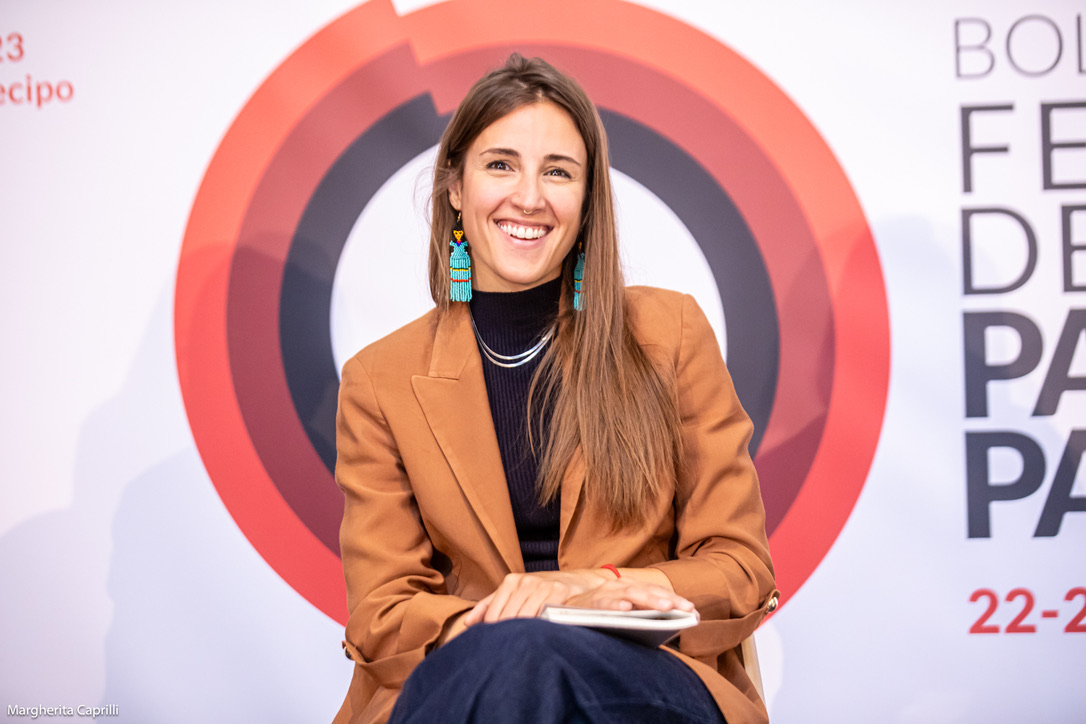
A direct democracy tool that allows citizens to report, ideate, and vote on improvement proposals for public spaces in their neighborhood and reference area; and to vote on the sectors deemed most important for the neighborhood’s public policies—urban greenery, mobility, education, and so on. This is Participatory Budgeting, which in the Municipality of Bologna has been active since 2017 and has already seen four editions, with 72,506 votes cast, 1,235 proposals admitted to voting, 53 proposals funded, 13 million in resources invested—7 from participatory budgeting, 6 from other resources—with a maximum of 500,000 euros for each neighborhood. “The most important element that Participatory Budgeting manages to generate is social cohesion and a sense of responsibility and stewardship for the care of a common good by the community,” says Erika Capasso in this interview with Driving Change, Delegate of the Municipality of Bologna for Participatory Budgeting, as well as for Neighborhoods, Civic Imagination, Third Sector Policies, New Citizenships, Social Inquiry, Circular Subsidiarity, and the Neighborhood Houses Project.
When was participatory budgeting introduced in Bologna?
In 2017. It is a project that arrived in our city with the previous administration; I inherited the delegation for participatory budgeting directly from the current mayor Matteo Lepore, who at the time was councilor for Civic Imagination, as well as for Culture, Sport, and Tourism, and who brought participatory budgeting to our city. To date, there have been four editions in Bologna: 2017-2018, 2019-2020, then a break due to both the pandemic and municipal elections, and then we held the 2022-2023 edition. This is a process that is far from consolidated in its form, a tool that sometimes is active and other times not: there are cities that have started it and then abandoned it. In Ferrara, an association active in the city’s civic fabric is studying and delving into this tool to try to implement it. There are quite a few complexities—it’s far from simple to use direct democracy tools, and it is by no means a savings in money, human or economic resources. It requires courage and true commitment, both political and administrative, because it allows for a redistribution of some decision-making power regarding how public resources in the municipal budget are used.
What kind of economic commitment does it require?
It is a tool that can be applied and used in varying degrees: Bologna started using it in 2017 with a cap of 100,000 euros per neighborhood, deciding to have the citizens choose through this direct democracy tool how those resources should be used. Through a participatory process—the neighborhood labs—and then through voting, citizens could express needs and requirements, transform them into projects, and with the vote, decide which projects to allocate the resources to. In 2017 and 2018, the cap was raised to 150,000 euros per neighborhood; in 2019 and 2020, it became 300,000 euros; and in 2022-2023, 500,000 euros per neighborhood. So Bologna has progressed, grown, and consolidated this tool. Even so, we’re talking about a very small percentage of the overall budget, below 1% even with the latest level of 500,000 euros per neighborhood, which for us means 3 million euros of the municipal budget. It’s not a small sum, but clearly, if we look at it in relation to the entire budget—over a billion euros—it’s a very limited percentage. When the tool was established in Porto Alegre, Brazil in the 1990s, that process concerned about 15% of the city’s public resources. So clearly we still have a long way to go.
On what topics was the project launched?
We started by giving citizens decision-making power over projects concerning the transformation of public spaces. Gradually, we brought them to also provide input on political priorities, giving them the opportunity to vote not only on physical transformation projects but also on what they prioritize in terms of neighborhood public policies: investing in urban greenery, education, local educational services, cultural welfare, or mobility. In short, we gave citizens space to indicate political priorities, which is a foundational element of the original vision for participatory budgeting. When resources reached 300,000 euros per neighborhood, a double level was introduced: one that today we could refer to, recalling principles of shared administration, as co-programming, an indication and direction on priorities; and another of co-designing, with votes directly for various physical transformation projects to be carried out in their neighborhood.
And then?
In the latest 2023 edition, we took an additional step, reaching 500,000 euros per neighborhood and maintaining the double level—physical transformation of a territory, and care for the community of that territory. In fact, one of the critical elements we identified in the first editions was inviting citizens to work only on physical transformation proposals: after the voting phase, citizens effectively no longer had a role. At that point, the responsibility and task for implementing the projects voted on by the citizens passed to the administration. This created a gap between the voting moment and the actual realization of the project, a void that risked fostering disengagement by citizens. What I believe is the most important element that direct democracy processes, especially participatory budgeting, can generate is social cohesion and a sense of responsibility and stewardship for a common good by the community.
What is the risk?
If we don’t find a way to nurture that care and responsibility among citizens, we risk failing to root a community, whereas the process should serve precisely that purpose. In the 2022-2023 edition, we decided that after the vote where citizens chose the priority project proposals, the process would continue to be constantly shared with the proponents’ community, who would in turn be responsible for involving the rest of the territory’s citizens. We increased the total resources to 500,000 euros per neighborhood, dedicating the budget to interventions for community care, rather than physical transformation. This ensured that even after the vote, people remained constantly involved in building immaterial activities together—focused on community care rather than physical transformation, but clearly aligned with the vision of the winning project. In this way, we kept citizen engagement active, while at the same time continuing to work with designers on the physical transformation project. In the six areas that each selected a winning project, we had a consistent presence and constant activation of these communities, which continued to be protagonists in caring for that part of the city.
Can you give an example of these immaterial projects?
One of our latest winning project proposals in a neighborhood, on the city’s border, involves a series of interventions on a square: greening, lighting, adding benches, and a covered gathering area for events. This square needs to rediscover its beauty, as a pleasant place for spending time together and creating networks of solidarity and mutualism—these are the real needs of that place. So, in building the physical transformation project together with the people, which takes time, design work, and bureaucracy, the community was asked what was needed in the meantime to engage the rest of the citizens in the project and respond to the community’s needs, as those resources must be distributed for the whole community’s needs. With participatory budgeting resources, speech therapy workshops for children were organized, living in social housing with economic and social fragility, families who may not afford certain learning paths. Also, after-school activities, events for socializing, a women-only yoga class accessible even to Muslim women who may not participate in mixed-gender classes.
What else?
Young people from the area were involved in making murals on public buildings—the neighborhood house, the school wall—for direct visual expression, funding co-design pathways to increase their sense of belonging and identity. They were also guided to create an Instagram page called Il villaggio dei colori (“The Village of Colors”), since their square is called Piazza dei Colori. Elsewhere, another neighborhood involved several associations in redesigning trail networks and some furniture and equipment along walking routes by the Savena river. While they were designing these physical interventions, for the immaterial activities, citizens organized workshops for children to discover the Savena, walks with families, urban trekking, all free, with shuttles for those with limited mobility. Activities that also help share with the rest of the community the sense of the project to be realized.
In what forms does citizen participation manifest?
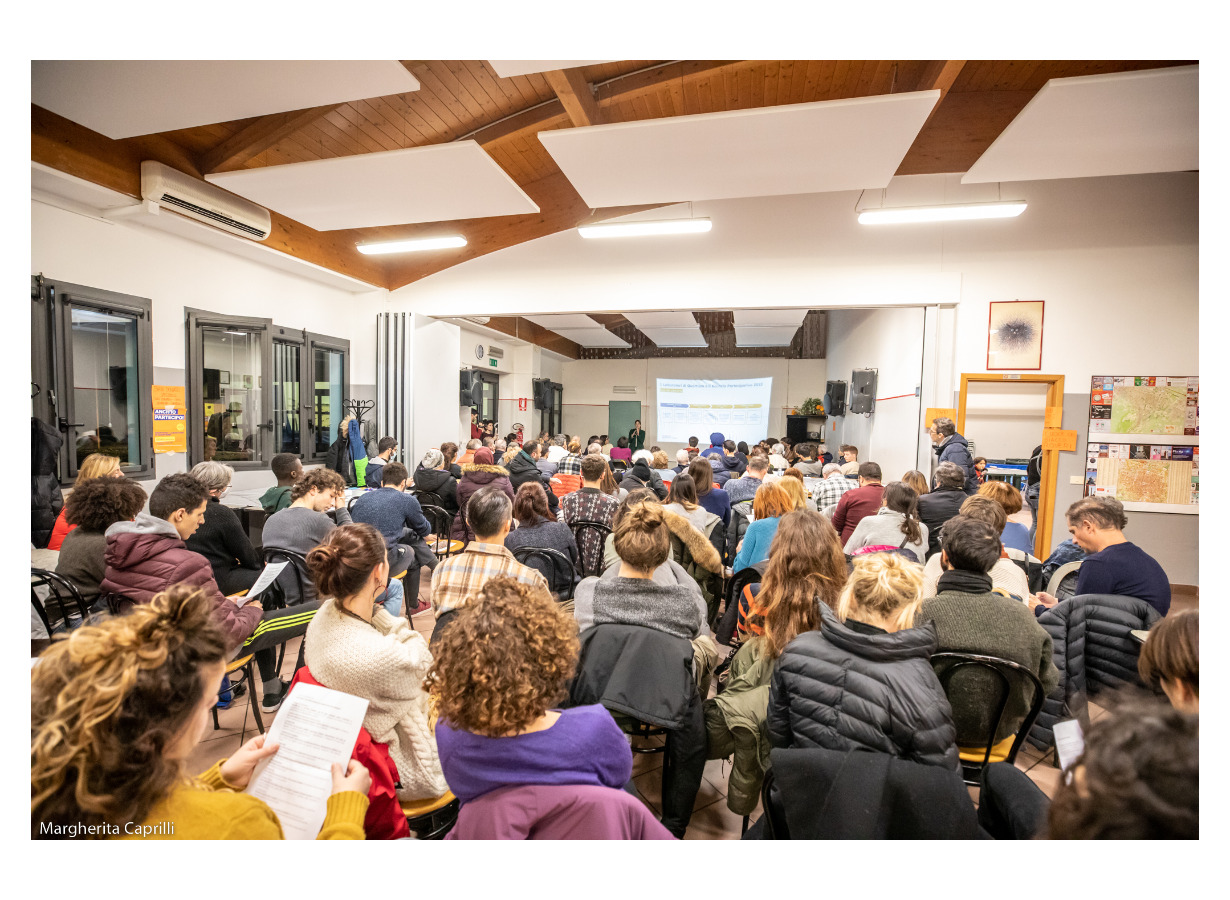
The process begins with an invitation to participate in neighborhood workshops held in person. People physically meet, and every citizen can bring their own needs, thoughts, ideas, or those of an existing group or association. At that stage, they are asked to fill out forms indicating the need and related project idea for a specific city area. There is also the possibility to do this online via the Partecipa platform, filling a form describing the idea tied to a need: taking care of a lawn, a basketball court, a school, a square, a location. Afterwards, the workshop process continues with citizens meeting, supported by colleagues from the Municipality of Bologna and the IU Rusconi Ghigi Foundation, to develop ideas into project proposals, also using tools such as maps to show what already exists, what is underway, what the Municipality is already implementing—to avoid citizen proposals being detached from reality. The information is not always available, yet it is the essential starting point for good, real, and not demagogic planning: basing it on real data is fundamental.
How many proposals were presented?
In our latest edition, we started with 385 ideas and as many forms filled out, arriving at 49 projects. We tried to bring together people with similar ideas or those based in shared territories. Once the projects were defined and reviewed by the technical team involved in the process—which must ensure feasibility, so that if the project wins, we can implement it as voted—a problem from the early years when we were still inexperienced was having projects voted without prior technical checks, risking afterward running into limitations that prevented implementation as designed, requiring changes. This causes great frustration among citizens, so it’s very important that this feasibility analysis happens beforehand, maintaining transparency and mutual respect, which becomes a bond of trust. If it is stated in advance that a certain project cannot be realized as initially thought, then it can be modified and a solution found before the vote.
And once the proposals are closed?
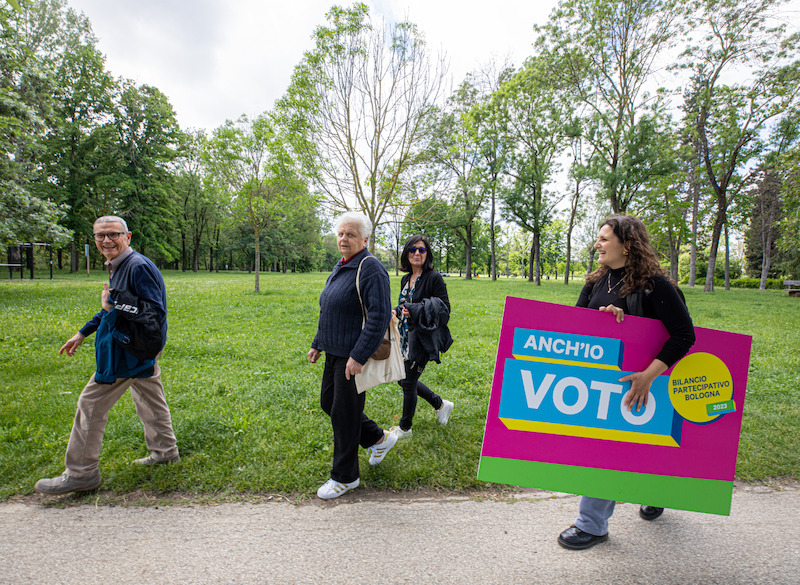
They go to a vote: on the Partecipa platform, all residents aged 16 and over in the Municipality of Bologna, as well as non-residents who work, study, or volunteer in the Municipality, can vote—for example, citizens without Italian nationality. Bologna is a university city, so it is important to include students who often do not register their residency here but live and study here. Thus, a self-certification of such conditions suffices, but the vote itself is via Spid. During the month-long voting phase, there are various physical polling stations around the city with municipal employees, network and neighborhood office staff, and proximity agents from the IU Rusconi Ghigi Foundation available to help those who may have digital difficulties in voting. In 2023 we had nearly 20,000 votes.
In recent years, citizen participation has tended to decline, including voting; instead, what feedback have you received? Is there interest among citizens in this kind of active involvement?
In Bologna, the crisis in participation is not felt; the city is very privileged in this regard, I realize we live in our own bubble from this perspective. But there is a point to consider: we need to move away from the idea that there is only one form of participation—I believe Bologna is a city that continues to show great and growing desire and responsibility for participation among citizens, manifesting in various ways, not just one. It may not only be about attending the participatory budgeting neighborhood workshop, but also conflictual ways of being present and expressing one’s desires, needs, or demands in the city, which I believe should be acknowledged and respected as forms of participation. So, in Bologna nothing is missing in this sense; there is great and ongoing activation through all tools—collaboration pacts, participatory budgeting, co-design processes for more structured third-sector organizations, but also students or more antagonistic groups who may not recognize these institutional practices but participate through their own, even independent, participatory paths. I think the real challenge is to recognize that this is nevertheless a positive sign for the city’s democratic fabric and to find channels for dialogue, not necessarily cooptation. The only form of participation that is really seeing a widespread crisis—this concerns us too—is the most traditional type of democratic involvement, voting. But I believe that providing space, time, and consistency in even direct or deliberative participation processes can absolutely strengthen and help representative democracy processes over time—I am absolutely convinced of this.
What is the outlook? What is your goal?
We are opening a process to reform the neighborhoods, thus reviewing our urban decentralization system: ten years after the last regulation, we are reopening a path to update local governance. This is also because, after eight years of experimentation with participatory budgeting, we feel we have reached sufficient maturity to systematize it. We feel the need to structure it as an actual model of city governance, of shared administration, with participatory budgeting and direct democracy structurally, permanently, consistently, and transparently used to define public policy priorities and manage public administration resources directly, territory by territory. We see these two levels integrating and joining—the goal is to understand how making participatory budgeting systematic can arise from reforming the neighborhood system, anchoring it as the neighborhoods’ operating method. To some extent, this is already true, but we need to formalize aspects, processes, and the amount of resources, so it is consistent year after year. It must be clear how many resources are allocated for each neighborhood, how the process is managed internally each year, with dedicated staff, so that it really allows territories to decide how resources are used and set up shared, bottom-up programming processes. The aim is to have neighborhoods initiate territorial programming processes and provide guidance for the entire organization’s programming—I believe this is the real challenge to fully and truly implement the participatory budgeting tool.